
Following Up on the Outcomes of the First Global Stocktake under the Paris Agreement
by Wolfgang Obergassel, Project Coordinator of ACCLIMATE
One of the research topics in ACCLIMATE is the five-yearly Global Stocktake (GST) under the Paris Agreement. Under the GST, the global community takes stock of its progress towards achieving the objectives of the Paris Agreement every five years. The Parties to the Paris Agreement are required to take the GST outcomes into account in the development of their subsequent NDCs.
As analysed in one of ACCLIMATE’s predecessor projects, NDC ASPECTS, the conclusion of the first GST at COP28 in Dubai in 2023 broke new ground for the international climate regime. The GST decision inter alia called on Parties to transition away from fossil fuels by 2050, and, by 2030, to halt and reverse deforestation and forest degradation, triple globally installed renewable energy capacity and double the speed of global energy efficiency improvements. After 30 years of discussing climate change mitigation only in abstract terms of emission targets, the Dubai decision thus broadened the focus to directly target the activities that are causing GHG emissions.
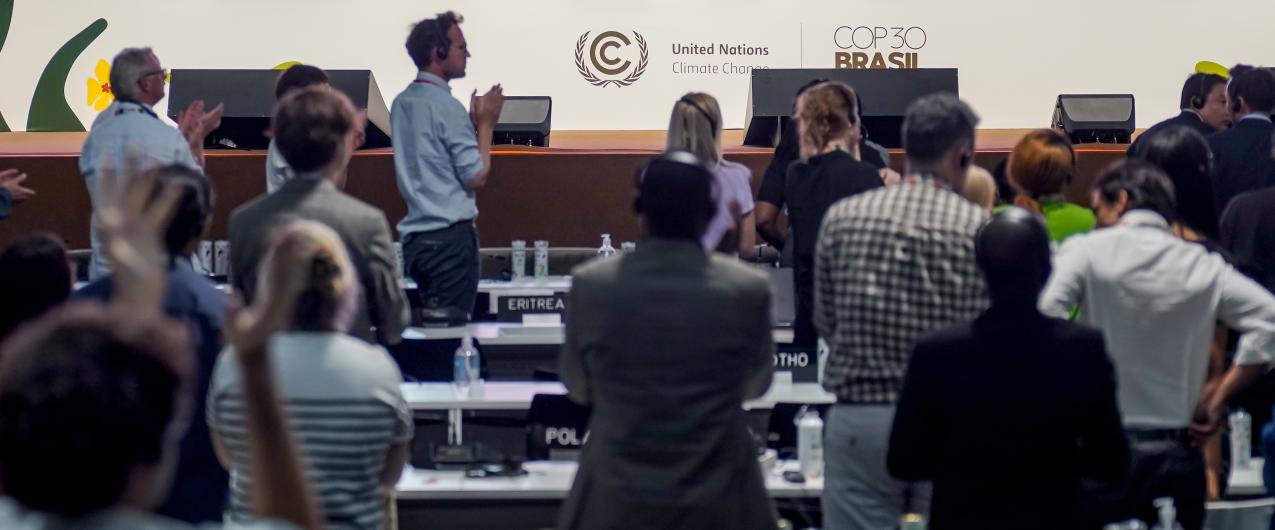
However, at the subsequent COP29 in Baku, recalcitrant countries, in particular the Arab Group and the Like-Minded Developing Countries, had successfully blocked all attempts at following up. On mitigation, the most important issue at stake in Belém was therefore whether the UNFCCC would be able to continue focusing on the transitions that are needed to achieve the mitigation objectives of the Paris Agreement - or would get forced back into discussing the global emissions gap only in abstract terms.
ACCLIMATE partner Wuppertal Institute recently published a first assessment of the outcomes of the Belém conference. The Brazilian COP presidency had pledged to secure a follow-up to the GST in Belém and Brazilian president Lula da Silva had suggested the development of roadmaps on ending deforestation and transitioning away from fossil fuels. Over the course of the conference the suggestion to develop a fossil transition roadmap was supported by more than 80 Parties. However, in particular the Arab Group and the LMDCs again objected to “targeting” specific sectors.
It was therefore again not possible to explicitly refer to the “global efforts” agreed on in Dubai in the outcome from Belém. Brazil announced that it will now develop roadmaps for phasing out fossil fuels and ending deforestation under its own authority outside the formal UNFCCC process. Colombia has announced that it will support the fossil fuel transition process by organizing an international conference together with the Netherlands. However, such parallel voluntary processes on fossil fuels and deforestation roadmaps must also lead to concrete measures. A plethora of international climate initiatives has been launched over the last decade but many of them provide only little added value. The ACCLIMATE project will monitor the progress of the two roadmap processes.
The project will also analyse in detail to what extent the GST outcomes are picked up nationally by Parties. Are countries actually reflecting the “global efforts” agreed in Dubai in their NDCs and national policies? If yes, to what extent is this actually due to the UNFCCC process, have the countries actually engaged with the GST outcome substantively, or are their NDCs only mirroring the international requirements without actual engagement on substance? And to what extent is international cooperation of countries being influenced by the GST outcome? First research results on these questions are due in late summer 2026.